
Guarding Industrial Equipment, Conveyors & Packaging Lines
Why required · The hazards · Conveyors · Packaging lines · Perimeter vs component · Design rules · How an order works · FAQ
Why your equipment is required to have guarding
Machine guarding goes by several names: barrier guarding, physical barriers, or industrial safety guarding. When it is measured and fabricated for one specific machine, the trade calls it custom machine guarding. Whatever you call it, industrial machine guarding is required by law on production equipment in every US state and every Canadian province, and nothing is grandfathered in. A conveyor line from the 1970s and a packaging cell installed this year carry the same obligation, whether the equipment runs in a manufacturing plant, a warehouse, or any other industrial or commercial facility where people work around moving machinery.
In the United States, the rule is OSHA 29 CFR 1910.212. It requires at least one method of guarding to keep workers clear of a machine’s hazards, including the point of operation, ingoing nip points, rotating parts, and flying chips or sparks. Wherever it can, the guard attaches to the machine itself, and it has to be built so no part of a worker’s body can reach the danger zone while the machine runs. This is not a fringe concern. Machine guarding appears on OSHA’s most-cited violations list almost every year, and the citations name the same equipment this page covers: conveyors, power transmission components, and production machinery.
Conveyors add one more US standard on top of the general rule: ASME B20.1, which covers conveyors and related equipment.
In Canada, the safeguarding-of-machinery standard is CSA Z432, currently Z432:23. It is enforced through each province’s occupational health and safety regulations, which in Ontario are Regulation 851, Sections 24 and 25. Ontario also adds a step that buyers from other provinces and from the US often haven’t run into: a Pre-Start Health and Safety Review (PSR) under Section 7 of Regulation 851. A licensed Professional Engineer conducts it, and it has to be done before certain new or modified equipment and safeguarding goes into service in a factory. If you are buying guarding for an Ontario plant, our Compliance Guide answers the PSR question, including how the Ontario PSR differs from the American “PSSR” (Pre-Startup Safety Review). The PSSR is a process-safety term for hazardous chemicals and has nothing to do with machine guarding.
The edition that applies to your equipment is the one your jurisdiction has adopted. Confirm it with your local authority before you design to a specific clause number.
What the guarding protects workers from
The same seven hazard types show up across industrial equipment. What changes from one machine to the next is where they concentrate:
- Entanglement: rotating shafts, couplings, and exposed keys, plus loose clothing near anything that spins
- Pinching and nip points (pinch points): the in-running nips where belt meets pulley, chain meets sprocket, or rollers converge, which is the defining conveyor hazard
- Drawing-in: the conveyor escalation of a nip, where a caught glove or sleeve pulls the hand in after it
- Shearing: reciprocating and converging machine elements
- Crushing: heavy moving assemblies, lift gates, and palletizing equipment
- Abrasion: moving belts and product-contact surfaces
- Electrical shock: exposed terminals on the motors, drives, and control panels along the line
OSHA sorts these into zones, and the zones are worth knowing because inspectors think in them. The point of operation is where the machine acts on the material. The power transmission apparatus is everything that drives the line: belts, chains, gears, pulleys, flywheels, and couplings, all moving constantly and usually sitting where the operator never looks. Everything else falls under other moving parts. On most production lines, the power transmission apparatus is where the unguarded hazards hide.
Every line should get a risk assessment against this list before any guarding is fabricated. Industrial buyers sometimes call this a machine guarding audit. Whatever the name, it happens before any steel gets cut.

Where the hazards live on a conveyor
Conveyor guarding is its own discipline because the hazards repeat at predictable stations along the run:
- Head and tail pulleys. The primary in-running nips, at the drive end and the take-up end.
- Drive assemblies. Motor-to-gearbox couplings and chain-and-sprocket or V-belt drives. This is power transmission apparatus, usually guarded by the OEM and usually missing its guard by year ten.
- Return idlers and return runs. Nip points on the underside that get forgotten because they sit below the sightline.
- Transfer points. Where one conveyor hands off to another, with converging belts, exposed rollers, and the temptation to reach in when product hangs up.
- Take-ups and counterweights. Stored-energy and crush hazards.
- Incline and elevating sections. Exposed return runs at worker height.
The design problem is never simply covering the hazard. It is covering the hazard while the line keeps running, because crews still have to clear jams, track belts, grease bearings, and change product on schedule. Guarding that fights the crew gets taken off, and a guard lying on the floor is a willful-violation citation waiting for an inspector to walk by. The design rules below are the answer: sectional guards sized for one person, perforated for inspection, with service and inspection access built in instead of improvised later.
One spec worth asking every supplier about is sweep space, the gap between the bottom of a barrier panel and the floor. It needs to be wide enough to clean under but tight enough that nobody can reach or crawl through. The right value depends on the application and the type of guarding.
Packaging lines: guarding from a machine builder’s perspective
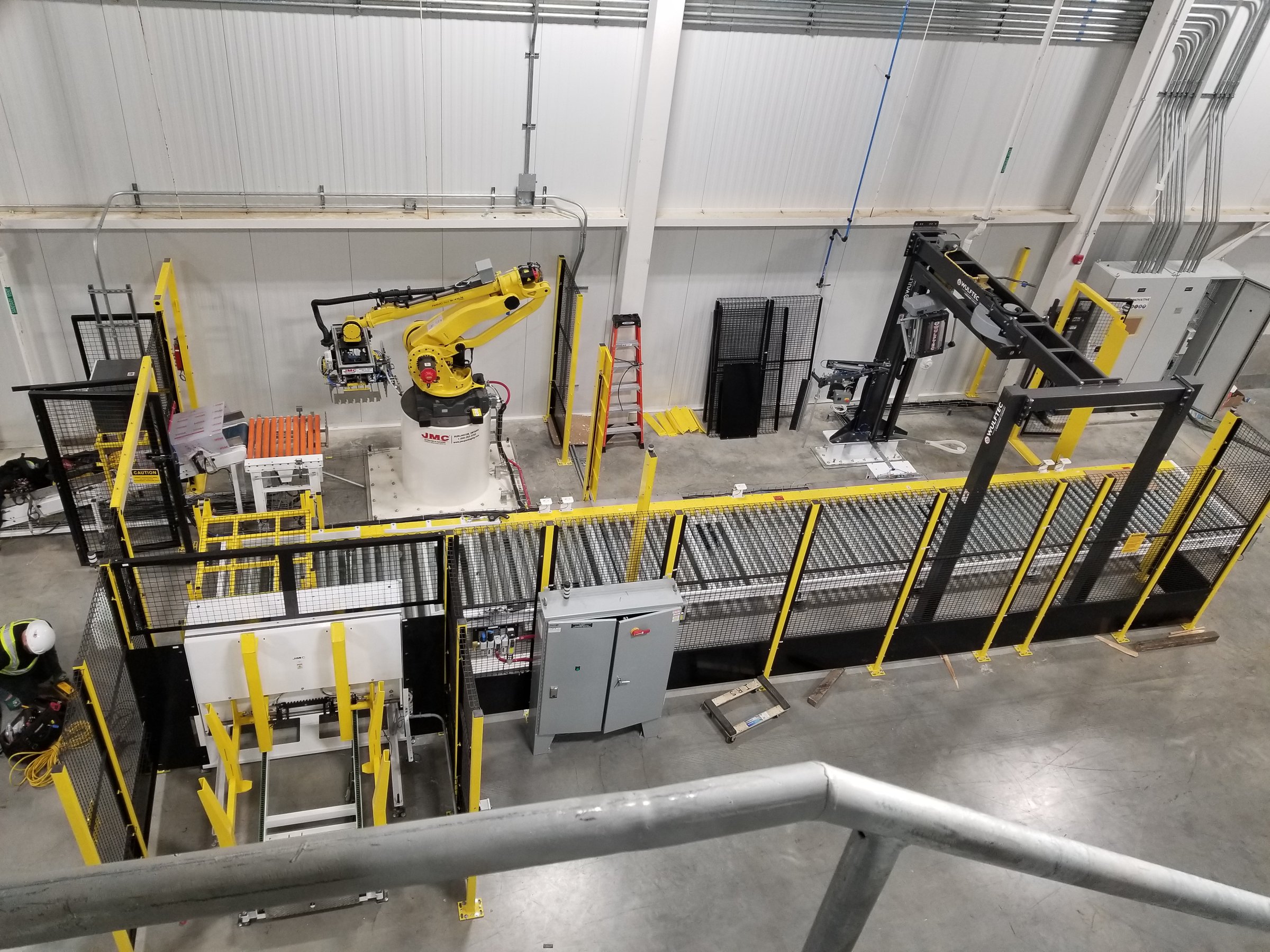
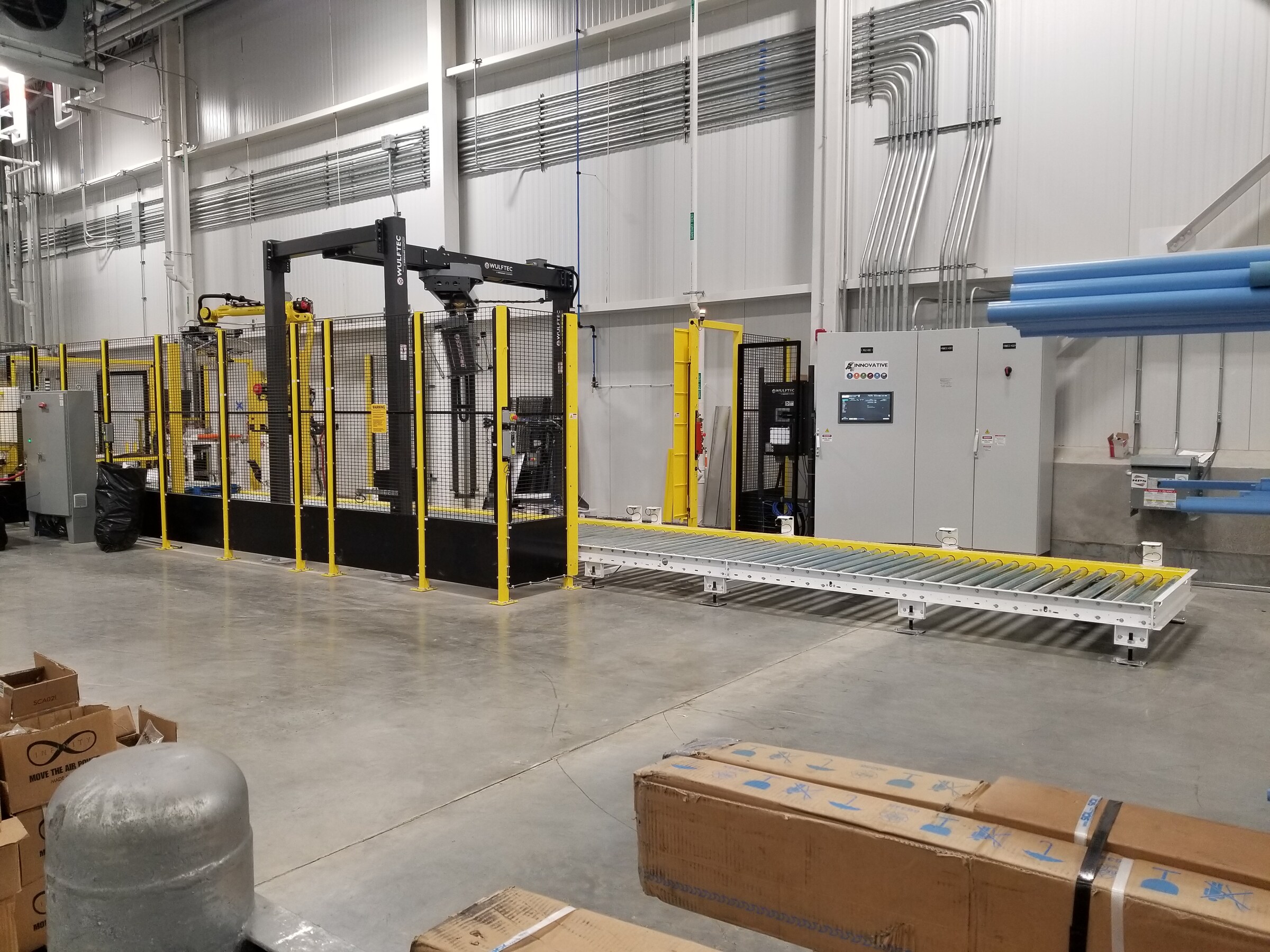
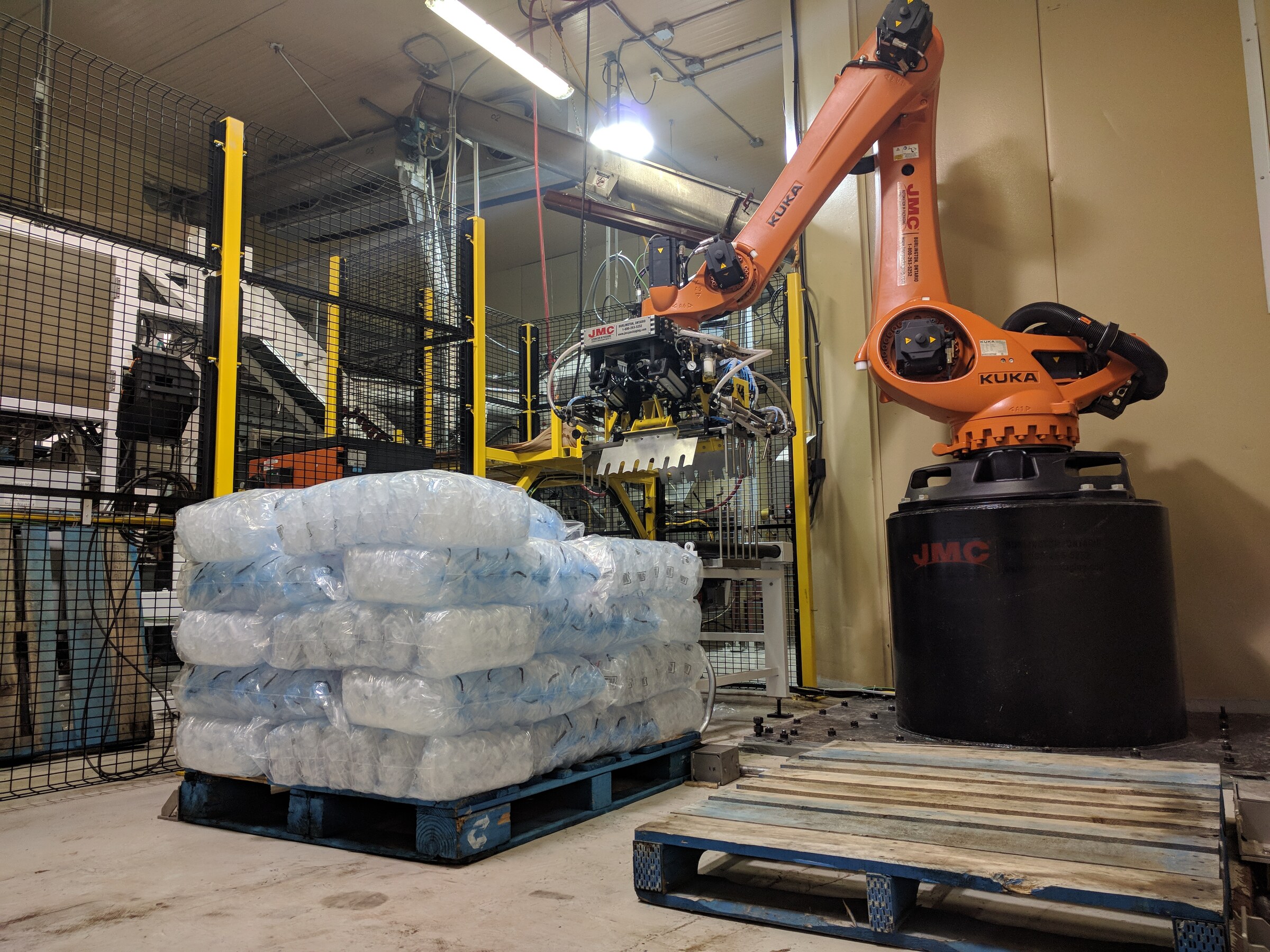
A packaging line concentrates every hazard on this page into one system. Baggers and form-fill-seal machinery carry point-of-operation hazards at the sealing and filling stations. Film and web handling adds in-running nips at the unwind and the drive rollers. Case and product conveyors link the whole line together, check-weighers and metal detectors sit mid-line, and palletizing waits at the end. Palletizing is increasingly robotic, which brings its own rules; we cover those on the robotic cell guarding page.
We know where these hazards concentrate because our group designs and builds automated packaging machinery. That side of the work shows you where the access points sit, how the changeover sequences run, and where the seams between machines fall. Guarding a line with that knowledge is a different job from fencing it from the outside.
Here is what that perspective changes in the guarding:
- OEM guards are the primary layer; secondary guarding fills the gaps. New packaging machinery arrives with point-of-operation guarding designed in. The exposures that remain are at the seams: the conveyor links between machines, the drive components added during integration, and the access points the line crew actually uses. Guarding those seams without duplicating the OEM’s work is a survey question.
- Changeover is the schedule-killer. Packaging lines change product, film, and bag size constantly. Guarding designed without the changeover sequence in mind adds minutes to every change, and then it gets left open. We design the access where the changeover happens.
- Legacy equipment is the real exposure. Lines run for decades, OEM guards disappear, and machines get modified. Older equipment with missing or improvised guarding is where citations and injuries concentrate. It is also where custom fabrication beats a catalog product, because nothing about a thirty-year-old line is standard.
- Mixed traffic decides the architecture. Forklifts, pallet jacks, and pedestrians share the floor with the line. Where traffic runs alongside the equipment, perimeter guarding does double duty. Where operators work at stations along the line, component guarding keeps them protected while they work.
Perimeter or component: the same choice as every machine room
Every compliant design uses some mix of two approaches. Perimeter guarding, also called global guarding, uses steel mesh barrier walls, posts, and access doors to separate people from equipment zones. That is MRG Global Guarding (GG series), and the Order Parts page handles quantity reorders. Component guarding puts an engineered barrier guard on each individual hazard, so a technician removes one guard for one task and stays protected from everything else. That is MRG Component Guarding (CG series).
On a production floor the deciding factors are traffic, how often people need access, and the layout of the line. Long conveyor runs through pedestrian areas lean toward perimeter guarding. Drive stations, nip points, and service points inside the envelope call for individual machine guards. Component work at this scale means coupling guards, shaft guards, chain guards, belt guards, and pump guards, each fabricated from survey dimensions. Most lines settle on one approach or the other, and some combine both into a single machine guarding system, with perimeter separation around the zone and component guards where the work happens inside it. Presence-sensing devices such as light curtains and switch mats have a place at high-frequency access points on powered machinery, but they depend on control-system integration and functional verification. Fixed barrier guarding protects without relying on a circuit. Which mix is right comes down to the survey.
That covers the essentials. The rest of this page is reference material: the design rules that decide whether industrial guarding survives in service, and how a project runs from survey to delivery.
Design rules that decide whether guarding survives production
The same checklist that governs our elevator machine room work applies on the plant floor. These principles are universal, and several of them are written into regulation:
- Guard every hazard the risk assessment identifies, during normal operation and during servicing, jam-clearing, and changeover.
- Never block inspection, lubrication, adjustment, or service access. Guarding that fights the crew gets left off, and a guard sitting in the corner of the shop is how the word “willful” ends up on a citation.
- Keep moving elements visible with perforated construction wherever condition is checked by eye, since belts, chains, and rotating components get watched while they run.
- Respect the reach-through rules, also called safety distances. Opening size sets the minimum distance from the hazard under ANSI B11.19 and CSA Z432.
- Use tool-operated fasteners. Nothing should come off by hand. If a guard can be removed without a tool in under ten seconds, it does not meet the standard.
- Size every section for one person and no lifting equipment, so it can be removed and reinstalled solo.
- Mind the sweep space. The gap under the barrier panels is a designed dimension, set to the application rather than left to chance.
- Respect the electrical working space. NEC 110.26 sets the clearance in front of panels and disconnects in the US, a minimum of 3 ft of depth and more depending on voltage and conditions; Canadian electrical rules use 1 m. A barrier built inside that envelope fails even if every moving part is covered.
- Plan secondary safeguards for any work that runs with the primary guarding removed. Equipment never runs unguarded without compensating protection, worked out in advance with the maintenance team. Lockout/tagout applies whenever guards come off for service.
- Post work instructions at the guarding that show how to access the equipment safely for inspection, testing, and maintenance, kept where the access actually happens.
- Document the design basis. The engineered drawings carry the substantiation, and a letter of conformity naming the standards the guarding was designed to is available on request.
How an order works
- Site review and survey. You send dimensions, or we survey, walking the line the way your crew runs it.
- Engineering and drawings. Every guard is drawn before it is built, designed to the equipment, the clearances, and the production schedule.
- In-house manufacturing. We fabricate in our own shop rather than brokering it out.
- Delivery. Guarding ships ready to install across the United States and Canada, and installation services are available depending on project scope and location.
Send us the line.
Send survey dimensions, photos, a layout drawing, or your consultant’s hazard assessment, whatever you have on hand. We will tell you what needs guarding, engineer the right mix of perimeter and component guarding for the equipment, and quote it.
Frequently Asked Questions
Is machine guarding legally required on conveyors and packaging equipment?
Yes, in every US state and Canadian province. OSHA 29 CFR 1910.212 requires guarding on machine hazards, including ingoing nip points and rotating parts, and ASME B20.1 adds conveyor-specific requirements. In Canada, CSA Z432 and provincial regulations such as Ontario’s Regulation 851 require exposed moving parts and nip hazards to be guarded. Older equipment is not grandfathered in.
What are the most commonly missed hazards on a conveyor?
Return-side nip points below the sightline, transfer points between conveyors, and drive components whose OEM guards were removed during past maintenance and never reinstalled. Head and tail pulley nips are the textbook hazards. The ones that get missed are usually on the underside and at the seams between equipment.
What is sweep space?
The gap between the bottom of a barrier guard panel and the floor. It needs to be large enough to sweep and clean under, but small enough that nobody can reach or crawl through. The right gap depends on the application and the type of guarding.
Do new packaging machines come with compliant guarding?
New machinery usually arrives with point-of-operation guarding designed in by the OEM. The exposures that remain show up at the integration seams, meaning the connecting conveyors, the added drives, and the access points, and on legacy equipment whose original guards have gone missing. The line as a system still needs assessment, even when every machine arrived guarded.
What is a Pre-Start Health and Safety Review (PSR), and do I need one?
In Ontario, a PSR under Section 7 of Regulation 851 is a review by a licensed Professional Engineer, required before certain new or modified equipment and safeguarding goes into service in a factory. It is an Ontario legal requirement. The similar-sounding US term “PSSR” (Pre-Startup Safety Review) comes from OSHA’s process-safety rules for hazardous chemicals and does not apply to general machine guarding. Our Compliance Guide covers the distinction. Confirm the requirements with your jurisdiction.
Should I use a light curtain or a physical barrier?
They solve different problems. Presence-sensing devices suit high-frequency access points on machinery with integrated, verifiable control systems. Fixed barrier guarding protects continuously without depending on a circuit, and it is the default answer for power transmission components, conveyor runs, and perimeter separation. Many lines use both, putting devices at the operator stations and barriers everywhere else.
Can MRG guard equipment that’s decades old?
Decades-old equipment is most of what we do. Custom fabrication exists precisely because legacy equipment is never standard. We survey the machine as it stands today, including whatever has been modified over the years, and engineer the guarding to fit it.
Does MRG install industrial guarding?
Guarding ships ready to install across the United States and Canada. Installation services are available depending on project scope and location, so tell us about the project in your quote request.
Do you build conveyor guarding?
Yes. Conveyor guarding is a core application for us: guards for drives, tails, and power-transmission components, and perimeter fencing where the layout calls for zone separation. Every guard is fabricated from survey dimensions, and ASME B20.1 sits alongside OSHA 1910.212 on conveyor work.