
MRG Collapsible Car Top Rails, Model TOC-C
What collapsible car top rails are
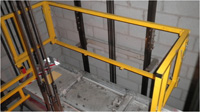
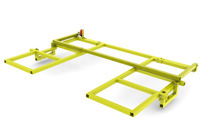
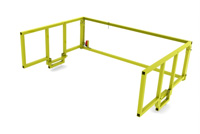
MRG Collapsible Car Top Rails (known in the trade as collapsible TOC railings, and also called car top handrails or car top guardrails) are folding guard rails for the top of passenger elevator cars and freight elevator cars. They deploy to working height when a mechanic accesses the car top and fold flat when the car is in normal service, clearing overhead obstructions that make a fixed-height railing impossible.
Every TOC-C rail is custom designed and engineered to fit the application. We work from survey dimensions, produce engineering drawings, and fabricate in-house. No catalog approximations, no field butchering to make a stock rail fit.
- Supplied with safety switches that have positive-opening (mechanically-opened) contacts for tying into the elevator control system, with both the stowed and fully deployed positions monitored through the existing safety circuit
- Custom-fit to the car, built from survey dimensions and engineering drawings
- Folds flat for normal service; deploys to working height for car-top access
- Typical construction: 1.5" × 1.5" HSS, powder coated yellow; larger cabs may require different materials
- Engineered for quick installation by elevator mechanics
Also available as a fixed configuration: MRG Fixed Car Top Rails, Model TOC-F
When a collapsible rail is the right answer, and when it isn’t
This is the question buyers actually need answered, and most suppliers skip it.
ASME A17.1/CSA B44 requires a standard railing on the outside perimeter of the car top on every side where a 300 mm (12 in.) ball can pass between the car-top edge and the adjacent hoistway enclosure, and on sides where there is no hoistway enclosure at all (clause 2.14.1.7.1 in A17.1-2019/CSA B44:19, the edition Ontario and many US jurisdictions enforce).
On a new installation designed to current code, overhead clearances accommodate a fixed railing, and a fixed rail is the straightforward answer. The code’s alteration provisions make the gate explicit: a stowable design is permitted only where conformance with the standard railing requirement is not possible due to existing overhead conditions (8.7.2.14.5.2).
The collapsible rail exists for the rest of the installed base: existing elevators with low overheads, where a fixed railing at compliant height would itself create a strike hazard against the overhead structure. The stowable retrofit path was first codified in the 2019 edition of the code, and it comes with specific conditions MRG rails are designed to meet: the rail’s stowed and fully deployed positions are each monitored by safety switches; the car runs normally only with the rail stowed, runs in top-of-car inspection operation only with the rail fully deployed, and doesn’t run at all in between; and the fully deployed rail must meet the code’s standard-railing requirements. In Ontario, the car-top rail retrofit wave began with TSSA Director’s Order 245/10, and the requirements have since carried forward into TSSA’s Code Adoption Document. MRG collapsible rails were designed to meet those requirements from the start.
Plain-language rule of thumb:
- New installation or generous overhead → fixed rail (TOC-F)
- Existing car, low overhead, fixed rail can’t achieve compliant height and clearance → collapsible rail (TOC-C)
- Not sure → send survey dimensions with your quote request and we’ll tell you which one the car needs
Confirm with your local jurisdiction. The edition enforced on your unit is the one your jurisdiction has adopted; confirm the adopted edition and any retroactive requirements with your local jurisdiction before ordering.
Code and standards context
Car top railings are fall protection under the elevator safety code. ASME A17.1/CSA B44 governs in both the United States and Canada. The current published edition is A17.1:2025/CSA B44:2025 (published January 2026), but the edition enforced on any given unit is the one adopted by that jurisdiction: state and municipal authorities having jurisdiction across the US (editions from 2010 forward), and TSSA in Ontario (currently A17.1-2019/CSA B44:19). Some jurisdictions also publish retroactive requirements for existing installations. Where the railing must sit back from the car-top edge, marking or striping of the exposed surface may also be required; confirm what applies to your unit with your local jurisdiction.
OSHA’s general industry fall protection requirements (29 CFR 1910 Subpart D) and the General Duty Clause apply to employers whose mechanics work on car tops. Our Compliance Guide covers the full standards landscape for elevator and machine guarding, including OSHA 1910.212, ANSI B11.19, CSA Z432, TSSA, and ASME A17.1.
MRG does not certify code compliance for your installation; your authority having jurisdiction does. What we do is engineer rails to your surveyed dimensions, supply the safety switches, with positive-opening (mechanically-opened) contacts, that the code provisions require, and build hardware that doesn’t become the reason a unit fails inspection.
Specifications
All specifications may vary by application. Every rail includes some amount of customization to fit the specific elevator.
| Attribute | TOC-C |
|---|---|
| Configuration | Collapsible / stowable car top railing |
| Safety switches | Supplied; positive-opening (mechanically-opened) contacts; stowed and fully deployed positions monitored for integration into the elevator control system / existing safety circuit |
| Deployed top rail height | 1070–1095 mm (42–43 in.) per ASME A17.1/CSA B44 2.10.2 |
| Folded (stowed) height | Varies by application |
| Latch | Pin and clip |
| Top rail & midrail | 1.5" × 1.5" HSS (typical; larger cabs may require different materials) |
| Toe board | 5 in. high, which exceeds the code minimum of 100 mm (4 in.) |
| Finish | Powder coat yellow, or custom at customer request |
| Mounting | Varies, typically bolted to crosshead; sometimes bolted to car top |
| Sizing | Custom, designed and engineered per application |
| Lead time | Quoted with each order |
| Ships to | United States & Canada |
How an order works
From first contact to delivery, the work happens in one shop:
- Site review and survey. We work from your survey dimensions, or arrange a site survey, at additional cost, depending on project scope and location.
- Engineering and drawings. Every rail is engineered and drawn before it’s built; a letter of conformity is available on request.
- In-house manufacturing. Fabricated in our own shop, not brokered out.
- Delivery. Shipped ready to install.
Who this is for
Elevator OEM project engineers and independent elevator contractors across the United States and Canada order TOC-C rails for modernization projects, inspection-driven retrofits, and maintenance-portfolio upgrades. Demand for collapsible rails has grown steadily as jurisdictions enforce car-top fall protection across the existing installed base.
MRG car top rails are in service with major elevator OEMs and independent contractors across the United States and Canada.

Our engineers work with your people to get to the solution the car requires.
The car is in a building somewhere on the continent, and we know someone has to get to it. Send us what you have: survey dimensions, drawings, or photos from your mechanic’s site visit. We’ll confirm fixed versus collapsible, engineer the rail to the application, and quote it.
Request a QuoteFrequently asked questions
When is a collapsible car top rail required instead of a fixed rail?
A collapsible (stowable) rail is permitted when an existing elevator’s overhead conditions make a conforming fixed railing impossible. It deploys for car-top access and folds flat in normal service. On new installations with adequate overhead, a fixed railing is the standard, code-conforming choice. Always confirm requirements with your local jurisdiction.
Do collapsible car top rails comply with ASME A17.1?
A17.1/CSA B44 requires a standard railing on every side of the car top where a 300 mm (12 in.) ball can pass between the car-top edge and the hoistway enclosure, and on sides with no hoistway enclosure. Where existing overhead conditions make that railing impossible, the code’s alteration provisions (8.7.2.14.5.2 in A17.1-2019/CSA B44:19) permit a stowable design meeting specific conditions, including position monitoring through safety switches and full standard-railing performance when deployed. The authority having jurisdiction makes the final compliance determination; confirm the adopted edition with your jurisdiction.
Why do the rails come with safety switches?
The code’s stowable-railing provisions require the rail’s position to be monitored: the car operates normally only with the rail fully stowed, operates in top-of-car inspection mode only with the rail fully deployed, and does not operate in between. MRG supplies safety switches with positive-opening (mechanically-opened) contacts on every TOC-C rail for integration into the elevator control system through the existing safety circuit.
What height is the top rail?
Deployed, the top rail sits at 1070–1095 mm (42–43 in.), the code’s standard-railing height, which a stowable rail must meet in its fully extended position. Each rail is sized to the car’s actual overhead conditions and the requirements that apply to the unit.
Are TOC-C rails custom-sized to the car?
Yes. Every rail is custom designed and engineered to fit the application, fabricated in-house from survey dimensions to engineering drawings. A letter of conformity is available on request. Typical construction is 1.5" × 1.5" HSS powder coated yellow; larger cabs may require different materials.
What’s the difference between Model TOC-C and Model TOC-F?
TOC-C is the collapsible configuration for low-overhead and retrofit conditions. TOC-F is the fixed configuration for cars with adequate overhead clearance. Same construction standard, same shop, same drawing process; the choice is driven by the car’s overhead survey. See MRG Fixed Car Top Rails.
Do you ship car top rails to the US?
Yes. MRG serves the United States & Canada, and rails ship ready to install, with lead time quoted on each order.