
MRG Component Guarding (CG Series)
 Request a Quote
What it is
Component guarding places an engineered guard on each individual hazard, with every guard built in removable sections. A technician takes off only the section over the component being serviced, working on it while staying protected from every other hazard nearby. Each guard is custom designed and fabricated from survey dimensions.
It’s barrier guarding engineered for individual pieces of equipment, in elevator machine rooms and across industrial guarding applications alike. Where perimeter guarding separates people from an equipment zone, a component guard goes on the hazard itself.
- An engineered guard per hazard: remove one, service one, stay protected from the rest.
- Flat and expanded metal construction, typically 11-gauge. Expanded metal keeps moving parts visible for inspection.
- Tool-operated fasteners: standard nuts, bolts, and screws, with nothing that comes off by hand.
- Sections sized for one technician, no hoisting equipment.
- Designed around inspection, lubrication, and service access. Guarding that fights the mechanic gets left off, and then the equipment is unguarded again.
- Custom-fit from survey dimensions and engineering drawings.
For zone separation with barrier walls and access doors, see MRG Global Guarding (GG series).
When component guarding is the right answer, and when it isn’t
The choice between component and perimeter guarding comes out of the survey, and the pattern is consistent.
Component guarding earns its place when the work happens at the equipment. The most service-intensive items, the machine brake, the governor, and the rope gripper, need hands on them routinely: adjustment checks, visual monitoring, periodic overhaul. A perimeter wall around that equipment protects nobody once the mechanic is inside it with everything running. A component guard protects the mechanic during the work, because only the guard on the component being serviced comes off.
It is also the answer where perimeter guarding physically can’t go: tight rooms where barrier walls would violate the elevator code’s maintenance clearances or the electrical working space in front of disconnects and controller faces, and single-machine rooms where fencing adds nothing a machine-mounted guard doesn’t already do.
Perimeter guarding wins where machines cluster and the floor plan allows a clean separation between people-space and equipment-space, which is faster to design and faster to install across multiple hazards at once.
Which approach the room needs comes out of the survey. Send us the survey, or your dimensions, and we’ll tell you.
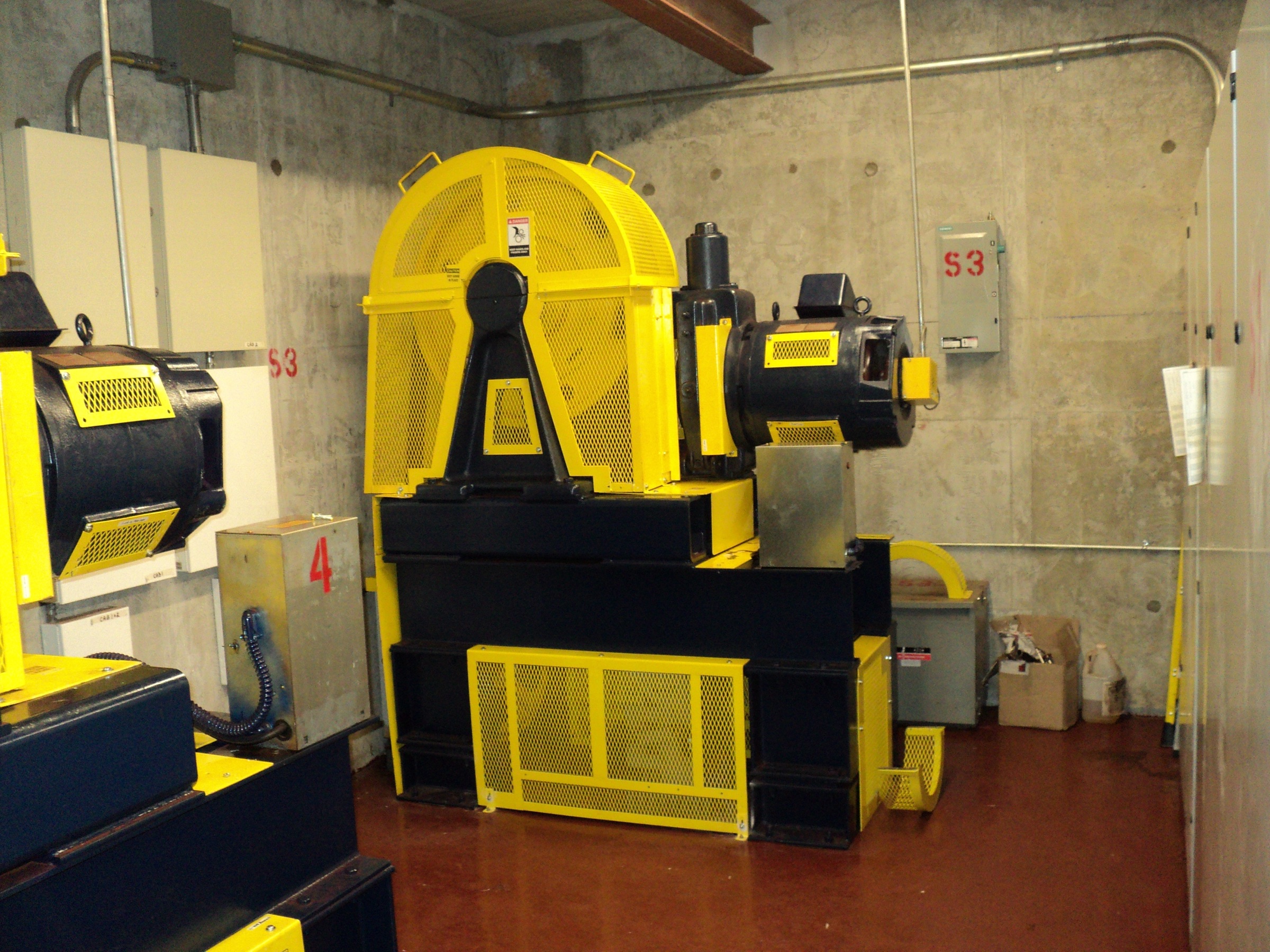
What gets guarded: the CG series scope
The component-by-component method applies the same way wherever moving machinery creates a hazard. In elevator work, these are the elevator machine guards an inspector expects to see over the sheaves, brake, and governor.
In elevator machine rooms
This is not an exhaustive list.
- Drive machine and drive sheave guards. The room’s defining entanglement and nip hazard, with openings sized so ropes and sheave grooves stay visible for inspection.
- Machine brake guards. Nip and crush protection, with adjustment points reachable and the drum surface visible.
- Motor guards. Drive motors and motor generator sets, with brush access and cooling airflow preserved.
- Governor guards and enclosures. Clearing the flyball swing arc, with switches, linkages, and the regulator’s seal accessible for inspection.
- Rope gripper guards. Screens designed for single-technician removal in awkward mounting locations.
- Deflector and secondary sheave guards. Sectional designs for low-overhead secondary spaces.
- Belt guards and covers, including the exposed V-belt drives on dry-type hydraulic units.
- Selector guarding, keeping original covers in service as primary guarding with tool-operated fasteners.
- Exposed electrical. Covers and shields for open-frame controllers and exposed live terminals.
Portions of counterweight equipment, and other equipment in the pit, can take component-style guards, fabricated through the same survey-and-drawings process as the machine room work. The counterweight itself, which travels up and down the hoistway, is most often guarded with a custom screen barrier guard.
On industrial & packaging equipment
This is not an exhaustive list.
- Rotating equipment: shafts, couplings, bearings, pulleys, sprockets, gears, and flywheels.
- Power transmission: belt, chain, and V-belt drives.
- Conveyor nip points: in-running rolls, return idlers, and transfer points.
- Reciprocating and shearing mechanisms: pinch and crush hazards on moving parts.
- Cutting equipment: saws and blades.
In industrial work, the same process produces coupling guards, shaft guards, chain guards, belt guards, and pump guards for plant equipment.
Application-specific guarding for conveyors, packaging lines, and robotic cells is covered on Guarding Industrial Equipment, Conveyors & Packaging Lines, which this page won’t repeat.
The deeper component-by-component reference (what each guard must do, and must not block) lives on the elevator machine room guarding guide.

Code and standards context
Machine guarding in elevator machine rooms is required by law in every US state and Canadian province: OSHA 29 CFR 1910.212 in the United States, and CSA Z432 enforced through the provincial occupational health and safety regulations in Canada (in Ontario, Regulation 851, Sections 24 and 25). The elevator code adds its own list: driving-machine sheaves and ropes, exposed gears, sprockets and selector drive components, and keys and screws in projecting shafts (clause 2.10.1 in A17.1-2019/CSA B44:19, the edition Ontario and many US jurisdictions enforce). Guard construction, opening sizes, and reach-through distances are governed by ANSI B11.19 (B11.19-2019, reaffirmed 2024) and CSA Z432:23, where the smaller the distance to the hazard, the smaller the permitted openings. Component guards must also respect the elevator code’s maintenance clearances and the electrical working space in front of disconnects and controller faces.
The current published elevator code edition is A17.1:2025/CSA B44:2025 (published January 2026), but the edition enforced on any given unit is the one your jurisdiction has adopted. The edition enforced on your unit is the one your jurisdiction has adopted; confirm the adopted edition and any alteration-filing requirements with your local jurisdiction.
MRG does not certify code compliance for your installation; your regulators do. What we do is engineer each guard to your surveyed equipment, design to the standards above, and document the design with engineering and installation drawings. The full standards landscape is covered in our machine room guarding guide and Compliance Guide.
A note on safe servicing
MRG designs and fabricates the guarding; the procedures for working on hazardous equipment are the employer’s responsibility. Every company should maintain its own health and safety policies and procedures for servicing hazardous equipment and for removing and reinstalling guards, and those procedures must meet all applicable legislation. Lockout/tagout is typically required before service. Component guarding is built to support safe service access; it does not replace your own safe-work procedures.
Design standards
Every CG-series guard is custom. These are the design rules every guard is built to.
| Attribute | CG series |
|---|---|
| Construction | Various metals, typically 11-gauge sheet metal; flat and expanded metal construction |
| Opening sizes | In accordance with the applicable guarding codes and standards (ANSI B11.19 / CSA Z432) |
| Fasteners | Tool-operated: standard nuts, bolts, and screws; nothing removable by hand |
| Section handling | Every section removable and reinstallable by one technician, no hoisting equipment |
| Service access | Adjustment, lubrication, and inspection points reachable with guards in place; partial-removal designs where inspection requires it |
| Clearances respected | Elevator-code maintenance path, 450 mm (18 in.), and electrical working space (min 3 ft per NEC Table 110.26(A)(1); 1000 mm in Ontario) |
| Finish | Powder-coated safety yellow, or special colors at customer request |
| Mounting | Typical fasteners or clamping, per component |
| Sizing | Custom, engineered per component from survey dimensions |
| Documentation | Engineering drawings and installation drawings; letter of conformity available on request |
| Lead time | Quoted with each order |
| Ships to | United States & Canada |
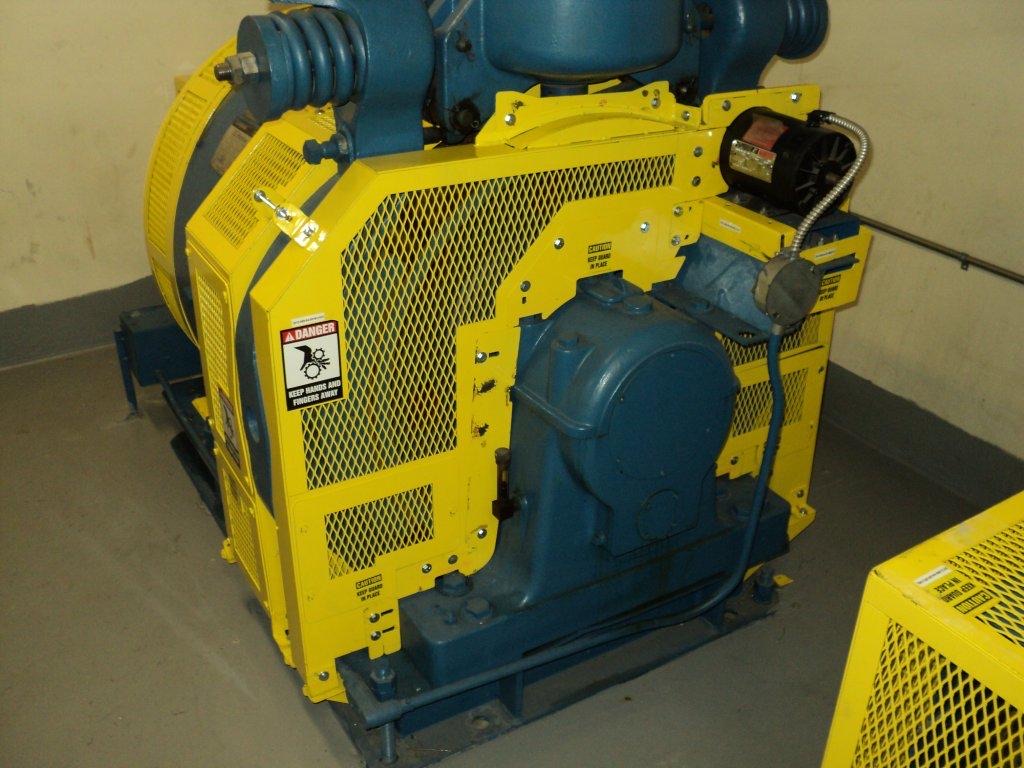
How an order works
From first contact to delivery, the work happens in one shop:
- Site review and survey. We measure, or you measure; either way, you work directly with our engineer.
- Engineering and drawings. Every guard is drawn before it’s built, with engineered drawings provided.
- In-house manufacturing. Fabricated in our own shop, not brokered out.
- Delivery with documentation. Shipped with engineering and installation drawings, ready for installation by qualified personnel.
Installation services are available depending on project scope and location.
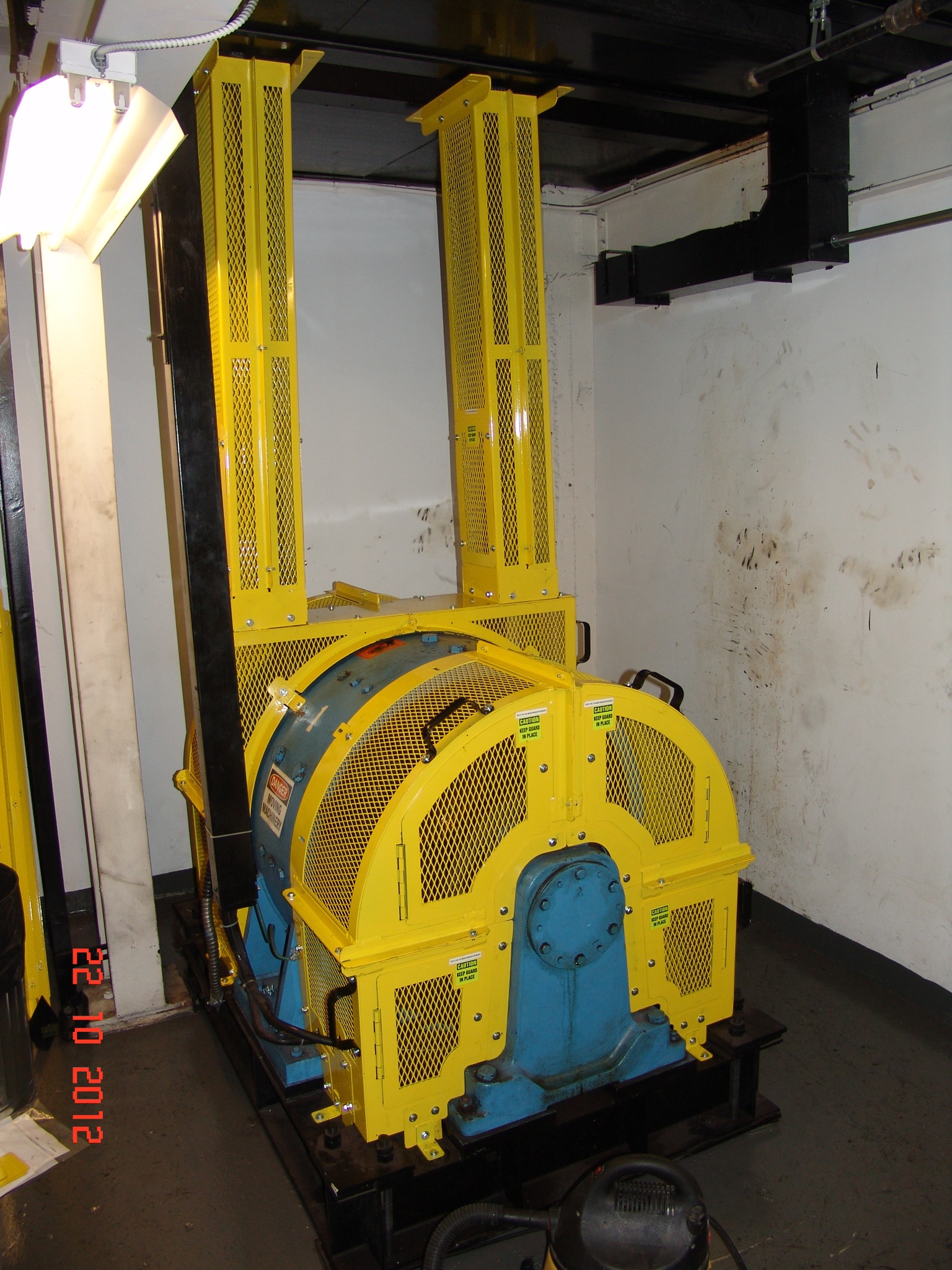
Who this is for
Industrial establishments; building owners and property managers, often the ones holding the citation or the consultant’s report; and elevator contractors throughout the United States and Canada. Component guarding orders typically follow an inspection finding, a consultant’s hazard assessment, a modernization scope, or a new build, whether industrial or elevator; MRG quotes from whatever you have, from full survey packages to a mechanic’s site photos.
MRG component guarding is in service in machine rooms maintained by the major elevator OEMs and independent elevator companies across the US and Canada.
Send us the room.
Survey dimensions, photos, or your consultant’s hazard assessment: whatever you have. We’ll identify what needs guarding, engineer each guard to the component and the clearances around it, and quote it.
Frequently asked questions
What is component guarding?
Component guarding puts an engineered guard on each individual hazard (a sheave guard on the drive sheave, a brake guard on the machine brake, an enclosure on the governor) instead of fencing off the whole equipment zone. Its advantage is surgical: a technician removes one guard to service one component and stays protected from everything else.
Can component guarding be combined with perimeter guarding?
Yes, though in practice most rooms end up with one or the other. There are cases where both apply: perimeter (global) guarding separating the equipment zone, with component guards on the equipment serviced inside it. Which mix is right is determined from a survey and a risk assessment rather than from a catalog.
Is component guarding required by law?
Machine guarding is required by law in every US state and Canadian province: OSHA 29 CFR 1910.212 in the US, and CSA Z432 with the provincial occupational health and safety regulations in Canada, with no grandfathering for older installations. Component guarding is one of the two compliant ways to meet that duty; the elevator code’s own equipment-guarding provisions name the components its list applies to. Confirm requirements and adopted code editions with your local jurisdiction.
Which elevator machine room components typically get guards?
The drive machine and drive sheave, machine brake, drive motor, motor generator set, selector, car and counterweight governors, rope gripper, deflector and secondary sheaves, and the belt drives on dry-type hydraulic units. More broadly, every moving part that could cause harm, and exposed electrical parts that could cause harm. Older machine rooms still running vintage equipment often have wide-open electrical, such as open-frame controllers and exposed live terminals, and by the rules, all of it should be guarded off. What each guard must do is covered component by component in MRG’s elevator machine room guarding guide.
Can a technician remove one guard to service one component?
That’s the design intent of the CG series: tool-operated fasteners and sections sized for one technician with no hoisting equipment. How and when guards are removed during service is determined by the elevator contractor’s hazard analysis and company procedures and policies.
Are CG-series guards catalog products or custom?
Custom, built on proven designs. We’ve guarded hundreds of Otis-, KONE-, Schindler-, and TK-type machines, so we have standard designs we adapt to each installation. The right guarding for a 1960s geared traction room with a motor generator set is not the right guarding for a 2010s gearless room. Every guard is engineered from survey dimensions to drawings produced in-house, then fabricated in our own shop.
Who installs component guarding?
Installation is typically performed by the elevator contractor. Requirements vary by US state, so confirm with your local jurisdiction. In Ontario, adding guarding to an elevating device is a defined alteration: filed with TSSA as a design submission and performed by a registered elevator contractor using certified elevating devices mechanics, or under their direct supervision. Installation services are available depending on project scope and location.
Does it ship to all locations in the US and Canada?
Yes. MRG serves the United States & Canada, and guards ship ready for installation, with lead time quoted on each order.
What documentation comes with MRG component guarding?
Engineering drawings produced from your survey dimensions, and installation drawings. A letter of conformity, identifying the standards the guarding was designed to, is available on request.
Do you make counterweight guards and elevator pit guards?
Yes. Portions of counterweight equipment and other equipment in the pit can be covered with component-style guards, built from survey dimensions with engineering drawings like the rest of the CG series. The counterweight itself, which runs up and down the hoistway, most often takes a custom screen barrier guard. Include the pit in your quote request and we will survey for it with the rest of the work.