
MRG Global Guarding (GG Series)
 Request a QuoteOrder GG Parts
What it is
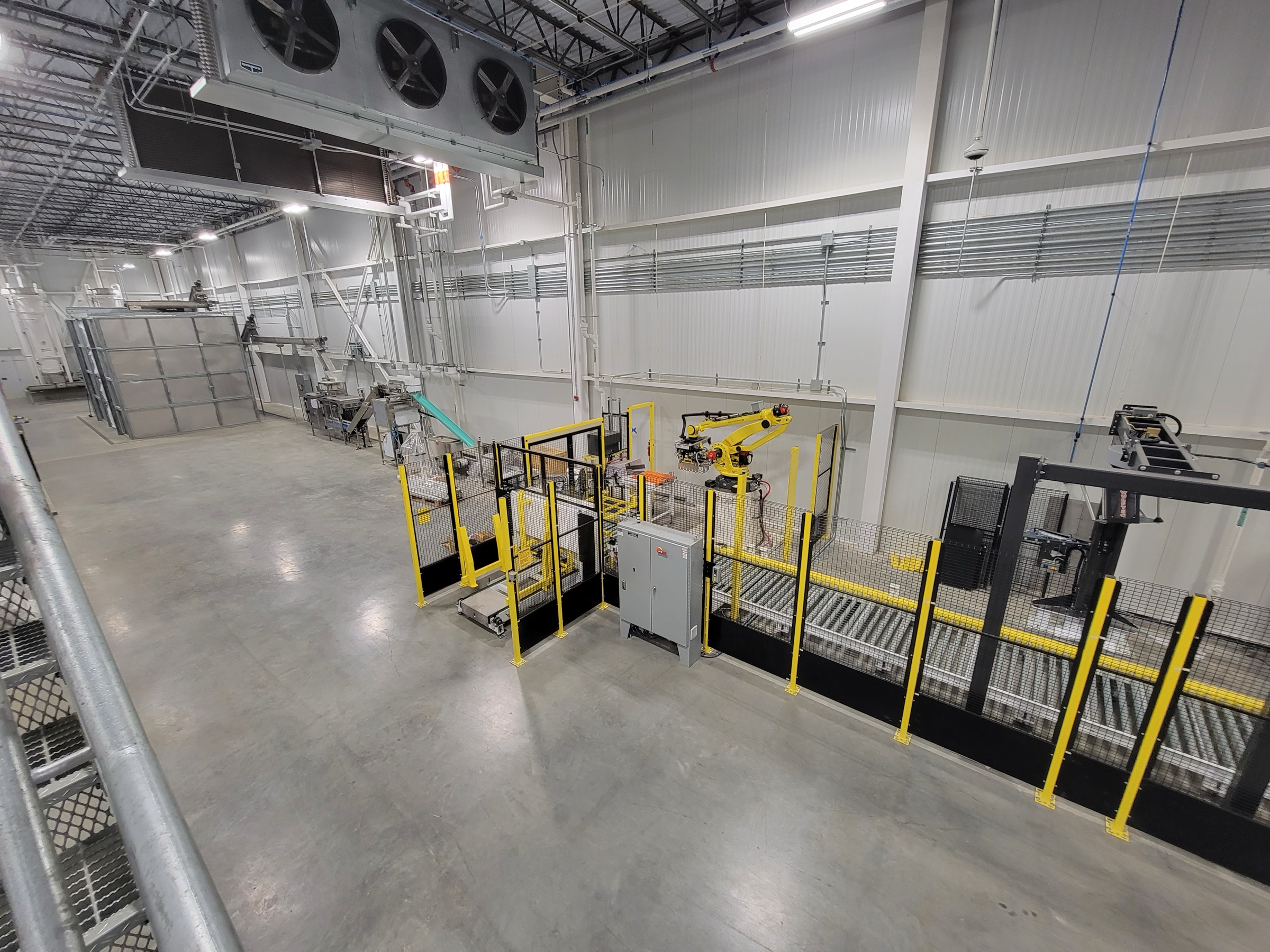
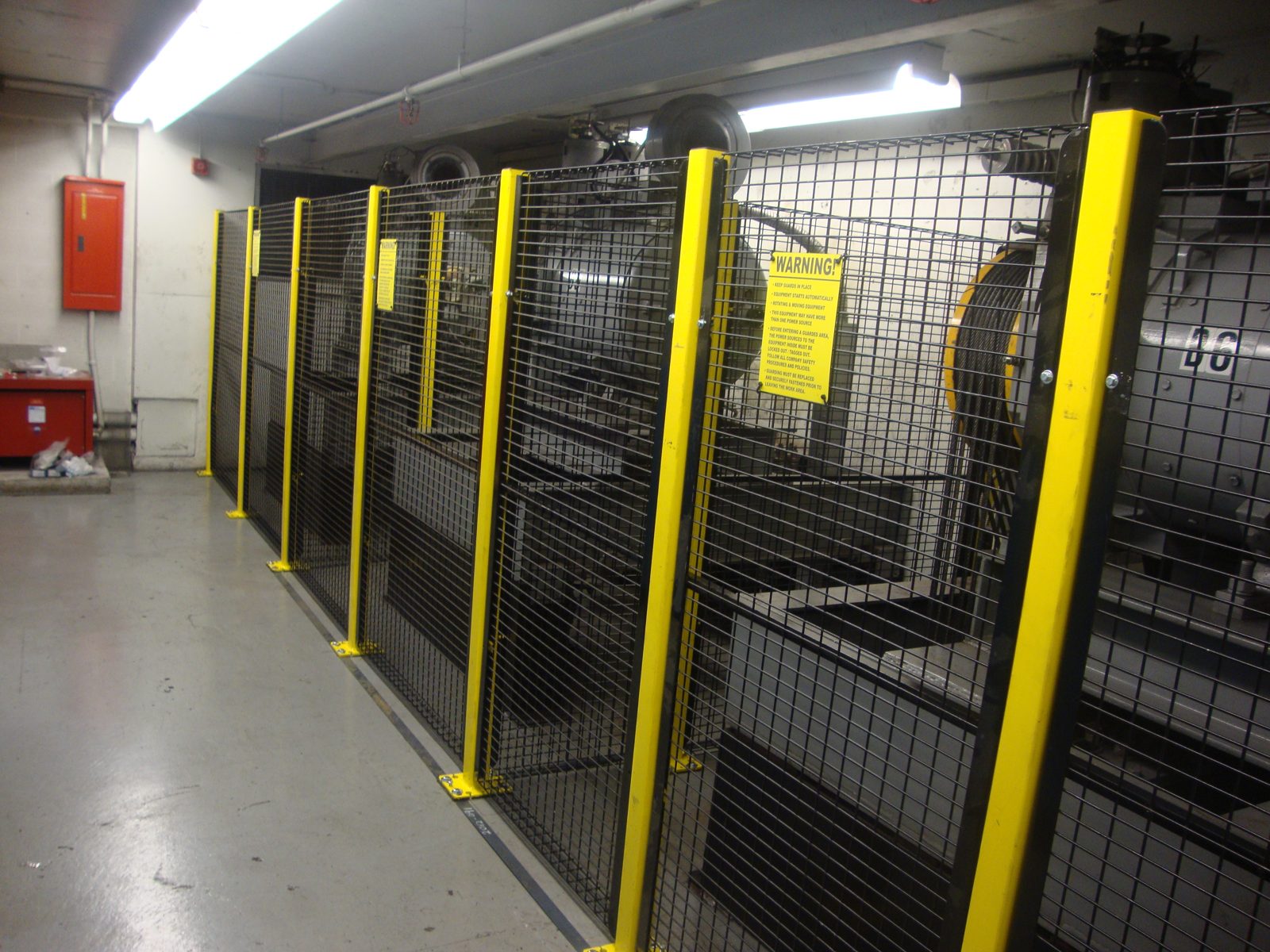
MRG Global Guarding, also called perimeter guarding, safety fencing, or a wire mesh partition, is barrier fencing that walls off an equipment zone and controls who gets inside it. It is built from a modular kit: welded wire mesh panels with formed sheet-metal frames, square steel posts, and lockable access gates, engineered and sized to the room it protects. The Global Guarding name is MRG’s own, in continuous public use on our product line for more than a decade.
The drawing below is a sample Global Guarding assembly. It shows how the panels, posts, and hardware bolt together into a section of fence. Use it to help work out what you need before ordering.

Where a component guard goes on the individual hazard, global guarding draws a line around the whole zone. It wins where machines cluster and the floor plan allows a clean separation between people-space and equipment-space, because one barrier line protects a technician from several hazards at once and a locked gate keeps the untrained out.
The system also carries electrical bonding continuity through the barrier, by way of bonding strips run under the post base plates from post to post. In a room full of exposed and sometimes live electrical, that is not an afterthought.
Every project is engineered and sized to the room, and built to the reach-through and clearance rules the code demands. The panels, posts, gates, and fittings then carry GG-series part numbers, so once a room is fenced, adding a run or replacing a panel is a part-number order, not a fresh engineering job. Standard sizes reorder directly through our parts order form; custom work goes through a quote.
- Modular system: welded wire mesh panels, through / tee / corner posts, and lockable access gates
- Mesh openings sized so a 1-inch ball cannot pass
- Engineered and sized to the room, respecting the code’s maintenance clearances and electrical working space
- Electrical bonding continuity built in, post to post
- Bolt-together with tool-operated fasteners; panels ship with their hardware, and each post anchors with an anchor kit
- Standard sizes reorderable by part number; custom panels and posts available on request
- Powder-coated safety yellow, or special colors on request
For guarding the equipment itself rather than the zone around it, see MRG Component Guarding (CG series).
When perimeter guarding is the right answer, and when it isn't
The choice between perimeter and component guarding is a survey question, not a catalog question, but the pattern is consistent.
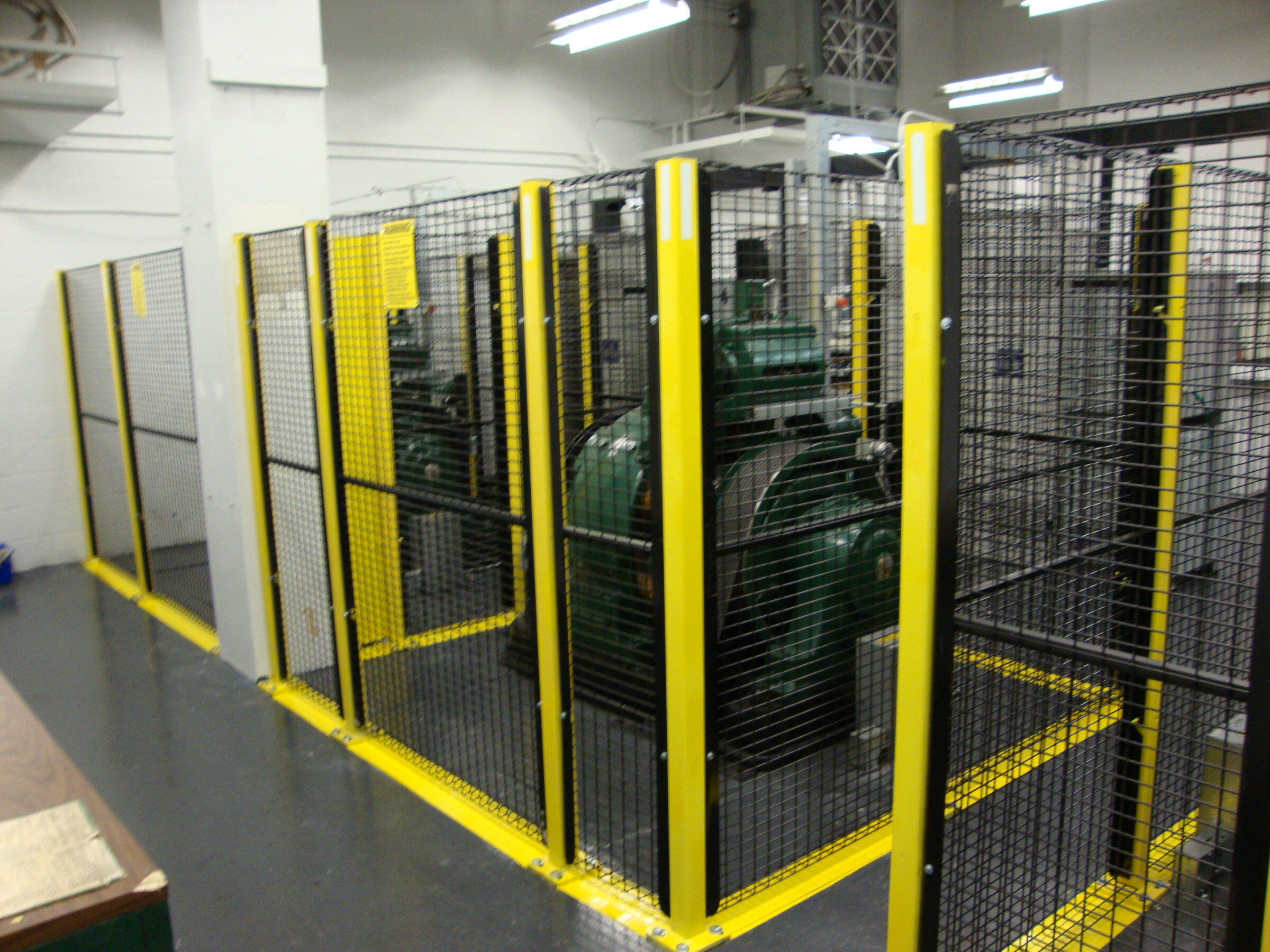
Perimeter guarding earns its place where machines cluster and the floor plan allows a clean separation between where people work and where the equipment runs. It is faster to design and faster to install across several hazards at once, and a lockable gate gives you access control that a component guard does not: the zone stays closed to anyone without a reason and a key to be in it.
It is not the answer in every room. In a tight machine room, a barrier wall can run afoul of the elevator code’s maintenance clearances or the electrical working space in front of disconnects and controller faces, and there is no room to stand a fence line without blocking one of them. In a single-machine room, fencing the room adds nothing a machine-mounted guard does not already do.
Component guarding wins where the work happens at the equipment. The most service-intensive items in a machine room need hands on them routinely, and a perimeter wall protects nobody once the mechanic is inside it with everything still running. A component guard protects the mechanic during the work.
Most rooms end up with one approach or the other. Cases exist where both apply: a perimeter line separating the equipment zone, with component guards on the equipment serviced inside it. Which approach the room needs is decided from a survey, not from a catalog. Send us the survey, or your dimensions, and we will tell you.
What the GG series is made of
Global guarding is a system of standard parts, all of which reorder by part number. Custom sizes are available on any of them, on request.
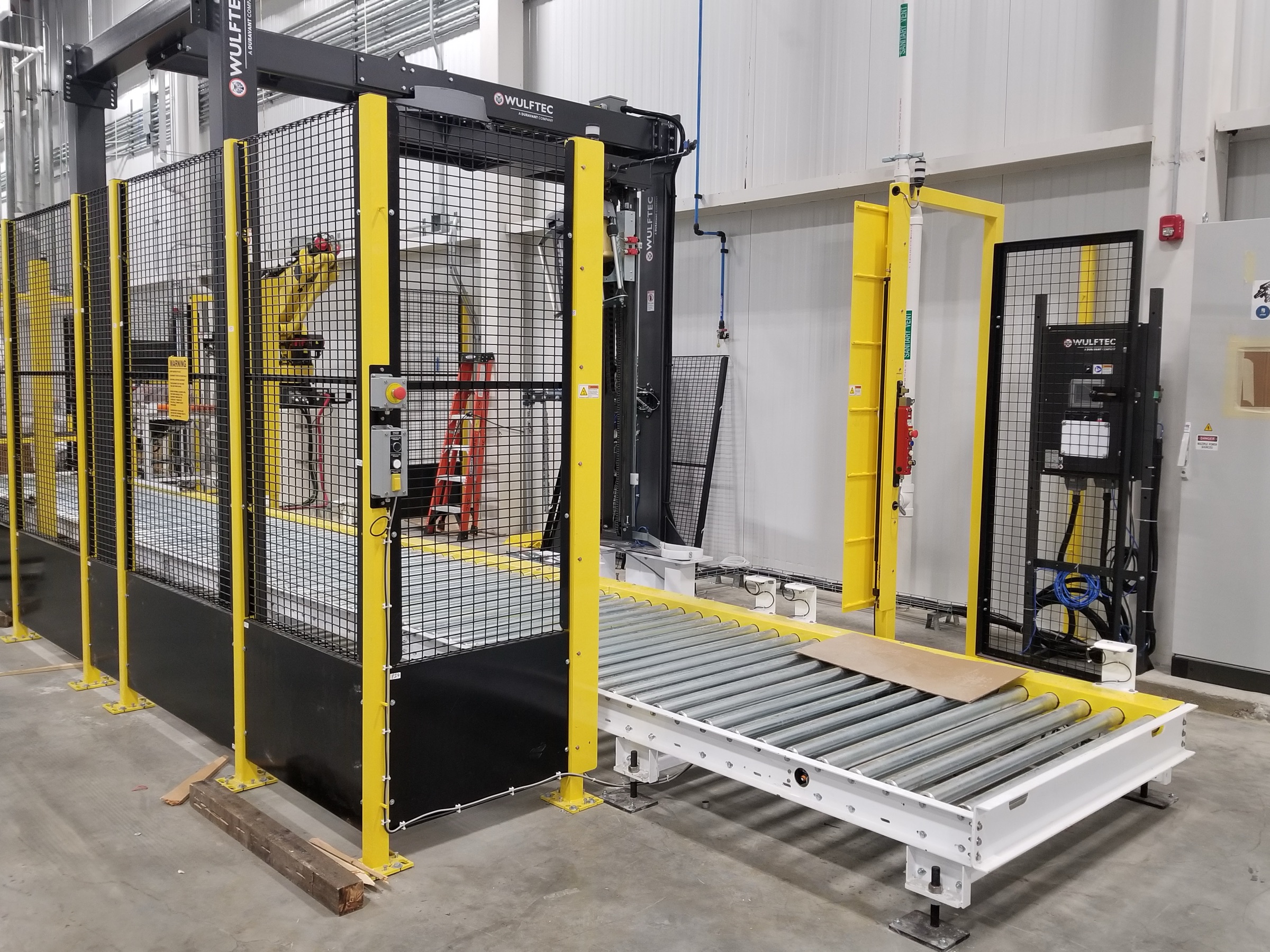
- Panels: welded wire mesh with formed sheet-metal side frames, in three widths: 48 in. x 70-1/2 in., 36 in. x 70-1/2 in., and 24 in. x 70-1/2 in. The mesh openings are sized so a 1-inch ball cannot pass. Panels ship with their mounting hardware.
- Posts: 2-1/2 in. x 2-1/2 in. square HSS, 72 in. high, capped, in three types: through posts (in-line), tee posts (junctions), and corner posts. Each post anchors to the floor with an anchor kit, one kit per post.
- Access gates: hinged gates with a hasp for locking. A gate is built from two posts and a modified standard panel, with hinges and a hasp added, and ships as a complete assembly with all hardware. Available as a single 36 in. gate or a double 36 in. gate, plus custom. Gate widths are sized at or above the minimum personnel exit-access width (OSHA 1910.36(g), 28 in.), which is why 24 in. is a panel width but not a gate width. Access doors are swing doors as standard. Custom sliding doors are also available, and doors fitted with interlock switches can be quoted on request.
- Wall plates: terminate a fence run cleanly against a wall.
- Fill plates and panel extensions: close the odd gap where a run does not land on a full panel; extensions come in left and right.
- Bonding strips: 16-gauge strips that run under the post base plates from post to post, maintaining electrical bonding continuity across the guarding. Sizes 49-1/2 in., 37-1/2 in., and 25-1/2 in., plus custom.
- Warning sign: the standard hazard sign for the enclosure.
Customization of all panels and posts is available, on request.
Once a room is fenced, reorders are part-number simple. Twelve more 48-inch panels is a GG-P48 line on the parts order form, not a new project.
Code and standards context
Machine guarding is required by law in every US state and Canadian province. OSHA 29 CFR 1910.212 governs it in the United States; CSA Z432 is enforced through the provincial occupational health and safety regulations in Canada (in Ontario, Regulation 851, Sections 24 and 25). There is no grandfathering for older installations.
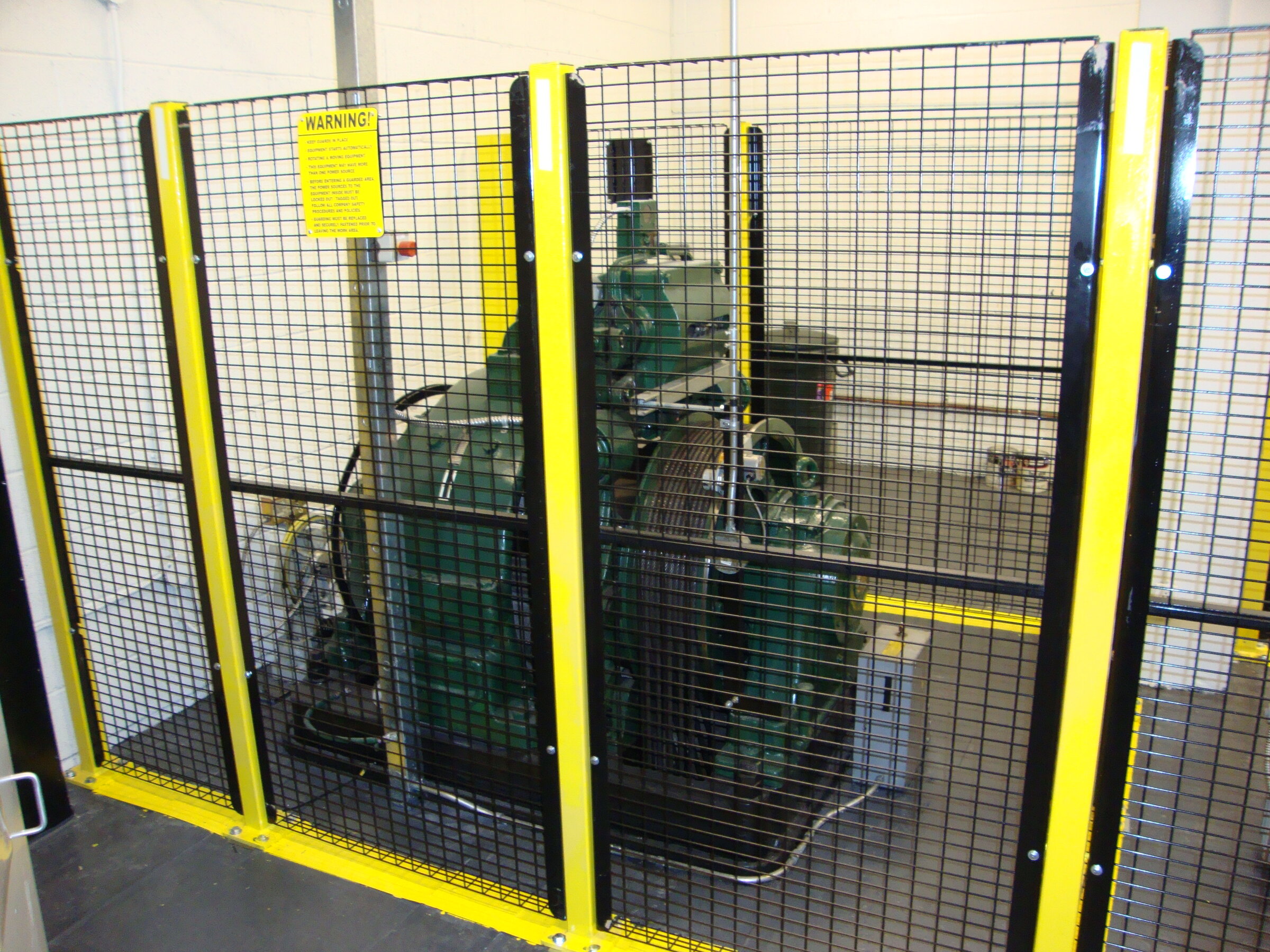
For a perimeter barrier, the governing detail is the relationship between the mesh opening and the distance to the hazard. Guard opening sizes and reach-through distances are set by ANSI B11.19 (B11.19-2019, reaffirmed 2024) and CSA Z432:23: the smaller the openings, the closer the barrier is allowed to stand to the moving part. Our standard mesh rejects a 1-inch ball, a small enough opening to let the fence line stand close where a room is tight, while still meeting the reach-through rules. Where a layout needs it, opening and placement are engineered together. A perimeter guard must also respect the elevator code’s maintenance clearances and the electrical working space in front of disconnects and controller faces.
The current published elevator code edition is A17.1:2025 / CSA B44:2025 (published January 2026), but the edition enforced on any given unit is the one your jurisdiction has adopted. Confirm the adopted edition and any alteration-filing requirements with your local jurisdiction.
MRG does not certify code compliance for your installation. Your regulators do. What we do is engineer each barrier to your surveyed room, design to the standards above, and document the design with engineering and installation drawings. The full standards landscape, including why two separate regulators have jurisdiction in every machine room, is covered in our machine room guarding guide and Compliance Guide.
Design standards
Standard sizes stock and reorder by part number. Every layout is engineered to the room. These are the design rules the system is built to.
| Attribute | GG series |
|---|---|
| Construction | Welded wire mesh with formed sheet-metal side frames; square HSS steel posts, capped |
| Panel sizes | 48 in. x 70-1/2 in., 36 in. x 70-1/2 in., 24 in. x 70-1/2 in., plus custom |
| Mesh opening | Sized so a 1-inch ball cannot pass |
| Posts | 2-1/2 in. x 2-1/2 in. square HSS, 72 in. high, capped; through, tee, and corner types |
| Access gates | Hinged, hasp for locking; single 36 in. and double 36 in., plus custom; built from two posts + a modified standard panel; ships complete. Sized at or above the 28 in. minimum exit-access width (OSHA 1910.36(g)); 24 in. is a panel width only |
| Fittings | Wall plates, fill plates, and left/right panel extensions to close and terminate a run |
| Electrical bonding | 16-gauge bonding strips under the post base plates, post to post; 49-1/2 / 37-1/2 / 25-1/2 in. plus custom |
| Fasteners | Bolt-together, tool-operated. Panels ship with their hardware; each post takes one anchor kit |
| Mounting | Posts on base plates, anchored with an anchor kit (1/2-13 drop-in anchors, 2 in. long) into concrete; one anchor kit per post |
| Clearances respected | Elevator-code maintenance path (450 mm / 18 in.) and electrical working space (min 3 ft per NEC Table 110.26(A)(1); 1000 mm in Ontario) |
| Finish | Powder-coated safety yellow, or special colors on request |
| Sizing | Standard sizes reorder by part number; custom panels, posts, and gates on request |
| Documentation | Engineering drawings and installation drawings; letter of conformity available on request |
| Lead time | Quoted with each order |
| Ships to | United States & Canada |

How an order works
There are two ways to order, depending on whether the room is new to guarding or already fenced.
A new room, or custom work:
- Site review & survey: we measure, or you measure; either way, you work directly with our engineer.
- Engineering & layout: the fence line, panel sizes, mesh, and gate locations are engineered to the room and the clearances around it; drawings provided.
- In-house manufacturing: fabricated in our own shop, not brokered out.
- Delivery with documentation: shipped ready for installation by qualified personnel, with engineering and installation drawings.
An already-fenced room, adding or replacing standard sizes: order by part number through the parts order form. No quote needed for standard sizes.
Installation services are available depending on project scope and location.
Who this is for
Industrial operations fencing off equipment lines; building owners and property managers; and elevator contractors throughout the United States and Canada. A first order is usually a quoted project, engineered to the room, whether industrial or elevator. After that, the same room reorders panels, posts, and gates by part number, which is why the GG series exists as a numbered system rather than a one-off fabrication each time.
MRG global guarding is in service in machine rooms maintained by the major elevator OEMs and independent elevator companies across the US and Canada.
Two ways to order.
New room or custom layout: send us the survey, photos, or your dimensions, and we will engineer the barrier and quote it. Already fenced and need more of a standard size: order it by part number.
Frequently asked questions
What is global (perimeter) guarding?
Global guarding, also called perimeter guarding, is barrier fencing that walls off an equipment zone and controls access to it, instead of guarding each hazard individually. It is built from welded wire mesh panels, square steel posts, and lockable access gates, engineered and sized to the room. Its advantage is coverage and access control: one barrier line protects a technician from several hazards at once, and a locked gate keeps the untrained out.
Can I reorder GG panels, posts, and gates by part number?
Yes. Every standard part in the GG series carries a part number, so once a room is fenced, adding a run or replacing a panel is a part-number order through our parts order form, not a new engineering job. Standard sizes reorder directly; custom sizes go through a quote.
What sizes do the panels and posts come in?
Panels come in three widths, 48 in., 36 in., and 24 in., all 70-1/2 in. high, with 2-1/2 in. square HSS posts 72 in. high in through, tee, and corner types to build any run. Panel height and layout are engineered to the room, and custom panel and post sizes are available on request.
How small are the mesh openings?
The standard mesh is sized so a 1-inch ball cannot pass through it. That small opening matters for more than keeping hands out: under ANSI B11.19 and CSA Z432, the smaller a barrier’s openings, the closer it is allowed to stand to the moving part, which is what lets a fence line fit a tight machine room. Where a layout needs it, opening and placement are engineered together.
Can perimeter guarding fit a tight machine room without blocking clearances?
Sometimes, and sometimes the room calls for component guarding instead. A perimeter barrier needs floor space to stand without blocking the elevator code’s maintenance path or the electrical working space in front of disconnects and controller faces. Where the room is too tight for that, guards mounted on the individual components are usually the answer. The survey decides.
Are custom panel and gate sizes available?
Yes. The standard sizes cover most runs and are what reorder by part number, but panels, posts, and access gates are all available in custom sizes on request, engineered to the room.
Who installs global guarding?
Installation is typically performed by the elevator contractor. Requirements vary by US state, so confirm with your local jurisdiction. In Ontario, adding guarding to an elevating device is a defined alteration: filed with TSSA as a design submission and performed by a registered elevator contractor using certified elevating devices mechanics, or under their direct supervision. Installation services are available depending on project scope and location.
Does it ship to all locations in the US and Canada?
Yes. MRG serves the United States & Canada. Global guarding ships ready for installation, with lead time quoted on each order.
What documentation comes with MRG global guarding?
Engineering drawings produced from your survey dimensions, and installation drawings. A letter of conformity, identifying the standards the guarding was designed to, is available on request.