
Guarding Robotic Cells: Perimeter Fencing and Safe Access
A robot work cell is guarded by putting a fixed barrier around the space the robot can reach, with controlled, interlocked access for the people who load, service, and program it. This page covers where that barrier goes, what current US and Canadian robot-safety standards require, and how the fence and gates are designed so the cell still runs the way your people work.

Why required · The hazards · Anatomy of cell guarding · Barrier vs presence-sensing · Design rules · How a project runs · FAQ
Why a robot cell is required to be guarded
Industrial robot cells are required to be safeguarded under law in every US state and every Canadian province, and the obligation does not expire with age: a cell installed in 2005 carries the same duty as one installed this year. The duty is enforced through occupational health and safety law, and the consensus standards below define what compliant safeguarding looks like.
In the United States, the governing consensus standard is ANSI/A3 R15.06-2025, the safety standard for industrial robots and robot systems. It was published in 2025 as a complete revision of the long-standing R15.06-2012 edition, and it is the US national adoption of ISO 10218-1:2025 and ISO 10218-2:2025. It now includes a dedicated part on the use of industrial robot cells. R15.06 sets requirements for the robot, for how a robot system is integrated, and for how the cell is safeguarded, including the perimeter barrier and the controlled access this page covers.
In Canada, the corresponding standard is CSA Z434. The long-standing edition, CAN/CSA-Z434-14, adopts the 2011 ISO editions. In 2026 CSA published the fourth edition, CSA Z434:26, the national adoption of ISO 10218-1:2025 and ISO 10218-2:2025 with Canadian deviations, which also references the companion technical report ISO/TR 10218-3 on industrial robot cells.
The general machine-safeguarding standards that sit underneath every guarding project, OSHA 29 CFR 1910.212, ANSI B11.19, and CSA Z432, are covered as subjects in our Compliance Guide. This page stays on the robot cell.
The edition enforced on your cell is the one your jurisdiction has adopted. Confirm the adopted standard and edition with the authority having jurisdiction before designing to it.
What the barrier protects against in a robot cell
An industrial robot differs from a fixed machine with a single point of operation. Within its reach, a robot arm can move at high speed and change direction without warning, and a person inside that space has no reliable way to predict or avoid it. The space the robot can physically reach is its operating envelope, and the larger zone kept clear of people during automatic operation is the safeguarded space. Guarding a cell means establishing that safeguarded space with a physical boundary and controlling every way a person can cross it.
The hazards a robot-cell barrier addresses include:
- Impact and striking. The arm or its payload strikes a person who has entered the reach envelope.
- Crushing and trapping. A person is caught between the moving robot and a fixture, a wall, or fixed structure inside the cell.
- The process the robot carries. Welding arc flash and spatter, material-handling loads, machine tending, and cutting each add their own hazards on top of the robot’s motion, concentrated at the tool and the workpiece.
- Shared-floor traffic. Forklifts, pallet movement, and pedestrians passing a cell that sits in an open production area.
A risk assessment identifies which of these apply to a given cell and defines the safeguarded space. That assessment is the responsibility of the cell’s owner and its integrator. MRG does not perform it. We build the physical barrier to the safeguarded space the assessment defines.
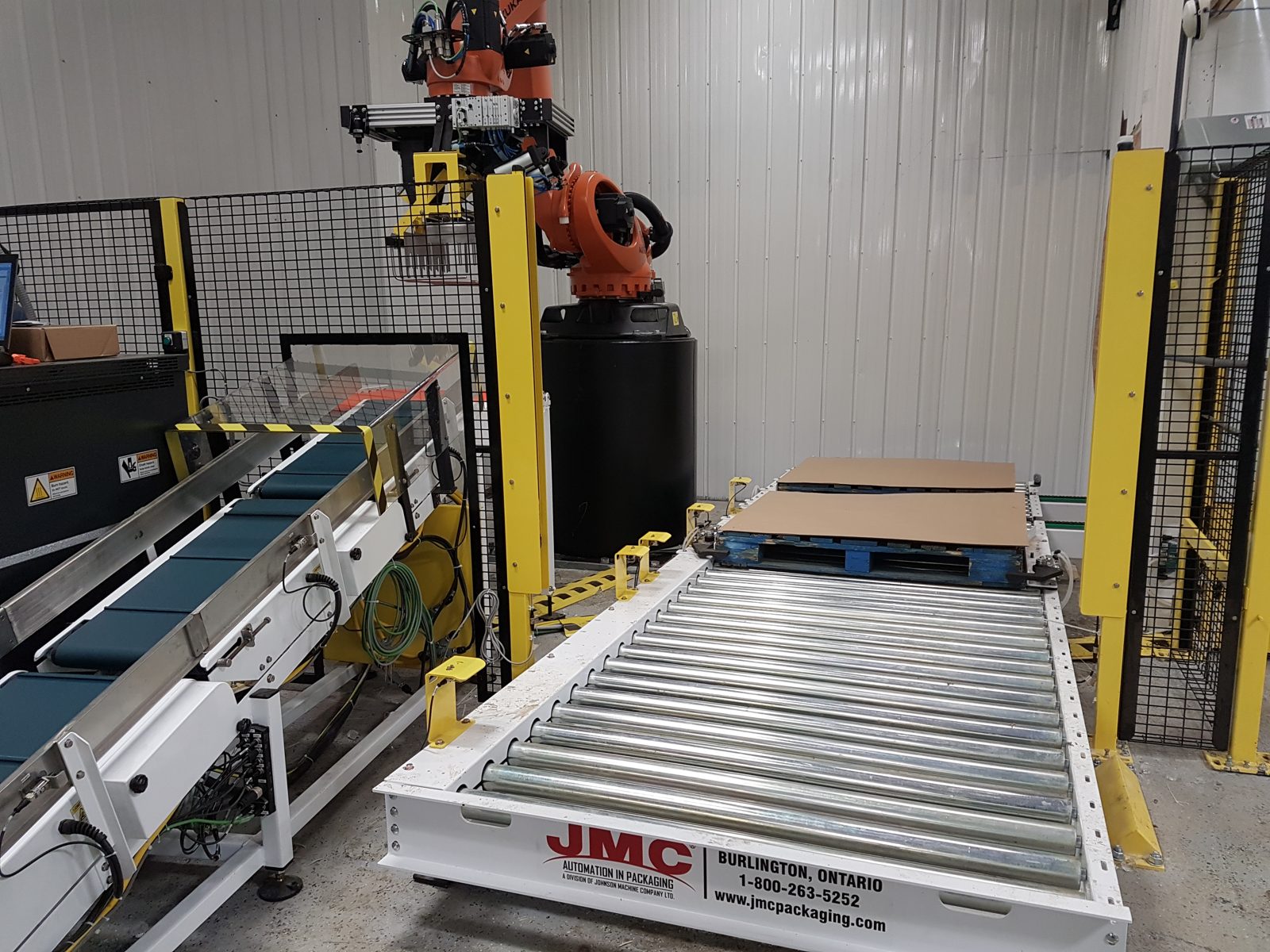
Anatomy of robot cell guarding
Guarding a robot cell is a system of four elements working together. Each is a place where MRG’s fabricated steel does its job. The trade also calls this work robot guarding or robot cell fence guarding, and the anatomy is the same under any of the names.
- Perimeter fencing. Steel mesh or panel barrier walls and posts that enclose the safeguarded space and separate people from the robot’s reach during automatic operation. The fence is positioned at a safe distance from the operating envelope so that a person at the barrier cannot reach into the hazard, with the distance calculated under the applicable standards.
- Interlocked access gates. Controlled entry points where personnel load parts, change tooling, clear faults, or service the cell. The gate is interlocked so that opening it commands a protective stop of the robot. MRG fabricates the gate and the barrier it sits in. The interlock device and its wiring into the safety circuit are part of the cell’s controls, supplied and integrated by the controls provider.
- Presence-sensing at access points. Light curtains and area scanners used where people need frequent, fast access and a swinging gate would slow the work. A presence-sensing device stops the robot when its field is broken. It depends on a functioning, verified safety circuit to do so.
- Fixed hard guarding at the process and the traffic side. Solid panels where weld flash, spatter, or debris must be contained, and reinforced barrier where shared-floor traffic runs alongside the cell. See Component Guarding for the engineered fixed-guard family.
The mesh or panel choice, the opening size, the post spacing, and the gate placement are set by the cell layout, the reach envelope, and how often people need inside. Those are survey questions, answered cell by cell.
Fixed barrier or presence-sensing: choosing for the cell
Most robot cells use both a fixed barrier and presence-sensing, because they solve different problems. The fixed perimeter barrier is the part of the safeguard that does not depend on power, software, or a circuit. A fence and a mechanically interlocked gate keep a person out of the robot’s reach whether the controls are working, mis-wired, mid-fault, or powered down. Presence-sensing is faster for the operator and right for high-frequency access points, and it protects only while its safety circuit is functioning and verified.
This is the distinction that decides the design, and it is the one MRG cares most about: the fixed barrier is the layer that survives a controls failure. Where a person could be reached by a high-energy robot, the standard answer is a hard barrier with interlocked access, with presence-sensing added where access frequency justifies it. Most cells end up with one approach or the other at a given access point, though some require both.
| Consideration | Fixed barrier guard | Presence-sensing device |
|---|---|---|
| During a controls or power failure | Continues to separate people from the robot’s reach | Stops protecting if the safety circuit is down |
| Best suited to | Perimeter enclosure, service-only or infrequent access, the traffic side | High-frequency operator access where a gate would slow work |
| Depends on | Mechanical integrity and correct installation | A functioning, verified safety control system |
| Access behavior | Interlocked gate commands a protective stop on opening | Robot stops when the sensing field is broken |
| MRG’s scope | Fabricates the barrier and the gate | Fabricates the structure and mounting; the device and circuit are the controls provider’s |
MRG’s role is the physical barrier. We fabricate the perimeter fencing, the interlocked gate structures, and the fixed hard guarding that enclose a robot cell. The robot, the safety controls, the interlock devices, the risk assessment, and the integration of the cell are the work of the robot integrator and the cell’s owner.
That covers what a robot cell requires and where the fabricated barrier fits. The reference below covers the design rules that keep robot-cell guarding compliant and serviceable, and how an MRG project runs.
Design rules that keep robot-cell guarding compliant and serviceable
The same design discipline that governs our machine room and industrial guarding applies to a robot cell, with the cell’s own constraints added. Several of these rules are written into the standards.
- Guard the hazards the risk assessment identifies. Under automatic operation and during the work people actually do inside the cell: loading, tool changes, fault clearing, and maintenance.
- Position the barrier at a safe distance from the reach envelope. A fence set too close lets a person reach the robot over or through it. The minimum distance is calculated under the applicable standards and confirmed by the integrator, and MRG builds the barrier to that line.
- Never impair access for loading, programming, and service. A barrier that fights the cell operators gets propped open or removed, and an open guard is both a citation and an exposure. Access is engineered where the work happens.
- Keep the cell visible. Mesh and perforated panel let operators and maintainers see the robot’s state through the barrier.
- Tool-operated fasteners on fixed panels. Fixed guarding comes off only with a tool, never by hand.
- One person, no lifting equipment. Every removable section is sized to be handled and reinstalled by one person.
- Respect electrical working space. Clearances in front of control panels and disconnects in the cell, under the US National Electrical Code and the Canadian Electrical Code, cannot be blocked by a barrier.
- Plan for service with the robot stopped. When panels or gates are open for maintenance, the cell runs under lockout/tagout and the integrator’s safe-operating procedures, never on the barrier alone.
Every MRG project is documented with a letter of conformity, available on request, identifying the standards the guarding was designed to meet.
How an MRG project runs
- Site review and survey. Your cell layout, robot make and reach data, and access needs, from your drawings or our survey. The safeguarded space comes from your risk assessment.
- Engineering and drawings. Every barrier, gate, and panel drawn to the cell, the reach envelope, the calculated safe distances, and the access points, before anything is built.
- In-house manufacturing. Fabricated in our own shop.
- Delivery. Shipped ready to install across the United States and Canada. Installation services are available depending on project scope and location.

Send us the cell.
Your layout, the robot’s reach data, photos, or your integrator’s safeguarding requirements, whatever you have. We will engineer the perimeter fencing, interlocked gates, and fixed guarding the cell requires, and quote it.
Frequently asked questions
Is guarding legally required on an industrial robot cell?
Yes. In every US state and Canadian province, occupational health and safety law requires industrial robot cells to be safeguarded. In the United States the recognized consensus standard is ANSI/A3 R15.06-2025, the 2025 national adoption of ISO 10218-1:2025 and ISO 10218-2:2025. In Canada the standard is CSA Z434, with the provincial OHS regulations and CSA Z432 applying as the general safeguarding layer. There is no grandfathering for older cells. Confirm the adopted edition with the authority having jurisdiction.
What is the difference between a fixed barrier and a light curtain on a robot cell?
A fixed barrier keeps people out of the robot’s reach by physical structure, whether or not the controls are working. A light curtain or area scanner stops the robot when its sensing field is broken, and protects only while its safety circuit is functioning and verified. Fixed barriers are the default for perimeter enclosure and infrequent access. Presence-sensing suits high-frequency access points. Most cells use both.
How far does the fence have to be from the robot?
Far enough that a person at the barrier cannot reach into the robot’s operating envelope before the robot stops. The exact distance is calculated under the applicable standards and confirmed by the cell’s integrator as part of the risk assessment. MRG fabricates and positions the barrier to that line.
Do the access gates need to be interlocked?
Where personnel enter the safeguarded space, yes. The gate is interlocked so that opening it commands a protective stop of the robot. MRG fabricates the gate and the barrier. The interlock device and its connection into the safety circuit are supplied and integrated by the controls provider.
Who is responsible for the risk assessment?
The owner of the cell and its integrator. The risk assessment defines the safeguarded space and the safe distances. MRG does not perform the risk assessment. We fabricate the barrier to the safeguarded space it defines.
Can MRG guard a cell built around an existing robot of any make?
Yes. Custom fabrication exists because no two cells are identical. We survey the cell as it stands, including the robot’s reach data and the access points your people use, and engineer the barrier to fit it, regardless of robot make or integrator.
The robot-safety standard was rewritten in 2025. Does that change the guarding?
The 2025 revision of R15.06 and ISO 10218 changed a great deal about robot controls, collaborative operation, and functional safety. The job of the fixed physical barrier is unchanged: keep people out of the robot’s reach and control how they enter. MRG tracks the current editions so the guarding we design references what your jurisdiction enforces. Confirm the adopted edition with the authority having jurisdiction.
Does MRG install robot-cell guarding?
Robot-cell guarding ships ready to install across the United States and Canada. Installation services are available depending on project scope and location. Tell us about your cell in your quote request.